

Most dog parents know exactly which side of the back seat their pup prefers. What a lot of dog parents don't know is whether what they're doing in the car is actually safe.
It's a fair question. The market is full of products labeled "safety this" and "secure that," and very few have been independently tested in a real crash. The short answer: the safest option depends on your dog's size, and the real test isn't the marketing copy — it's whether the product has been crash-tested by an independent lab. Let's walk through it.
What Makes a Dog Car Seat Safe?
A safe car seat — or harness — has one job: keep your pup from becoming a projectile in a sudden stop or crash. Everything else is secondary. That comes down to four things:
- Independent crash testing. The gold standard is the Center for Pet Safety, the only U.S. nonprofit running real crash tests on pet travel products and publishing results.
- Reinforced construction. Wide padded straps, heavy-duty stitching, metal buckles (not plastic).
- Properly anchored attachment. A single clip on a flimsy strap isn't going to hold a 60-pound dog in a 30-mph stop.
- Sizing that matches your dog. A medium-dog harness on a large dog is a failed harness. Sizing isn't a guideline — it's part of the safety.
Everything else — the cute pattern, the elevated view, the side pocket for treats — is a nice-to-have.
Why Dog Car Safety Matters
An unrestrained dog in a moving vehicle isn't just a risk to the dog — it's a risk to everyone in the car. In a crash at just 30 mph, a 60-pound dog hits with the force of roughly 2,700 pounds. The AAA Foundation for Traffic Safety has flagged unrestrained pets as a serious distraction and crash-injury risk for years, and the AVMA recommends restraining pets in vehicles for the safety of pet and people alike.
Being upfront about this is part of how we do things around here. The fix is straightforward: pick the right gear, fit it properly, use it every time.
Types of Dog Car Seats
When people search "dog car seat," they usually picture one of two products. Both have a place, but they work very differently.
Booster Seats for Small Dogs
A booster is a raised, padded box that sits on your back seat, secured by the vehicle's seatbelt. Your pup sits inside, clipped in by an internal tether that attaches to their harness.
Great for dogs up to about 20–25 pounds: the height helps with motion sickness and car anxiety, and the contained space keeps a small dog from sliding around. Honest cons: weight-limited, and many aren't crash-tested. The tether also relies on a properly fitted harness — never a collar.
Enclosed and Full-Body Dog Car Seats
These look like a structured dog bed with high walls, often with a zipper top. They give anxious or smaller dogs a contained, den-like space while keeping them buckled in. Same weight limits (usually 25–30 pounds max), and again — most aren't crash-tested. "Designed with safety in mind" is not the same as "tested in a 30-mph collision."

Car Seats With Safety Buckles and Tether Systems
A proper tether system has three things going for it. It's anchored to a strong point — the vehicle's seatbelt or LATCH anchors. The connection to your dog is a harness, not a collar. And the tether is short enough to prevent forward throw, but long enough that your pup isn't stuck in one rigid position.
If you're shopping a booster or enclosed seat, the buckle and tether are what matter. A flimsy plastic clip on a stretchy strap isn't a safety system — it's a comfort accessory.## Dog Car Seats vs Safety Harnesses
This is the question we get most. The honest answer: they solve the same problem for different sizes of dog.
A car seat (booster or enclosed) makes sense for small dogs. Below about 25 pounds, a booster gives your pup visibility, containment, and comfort.
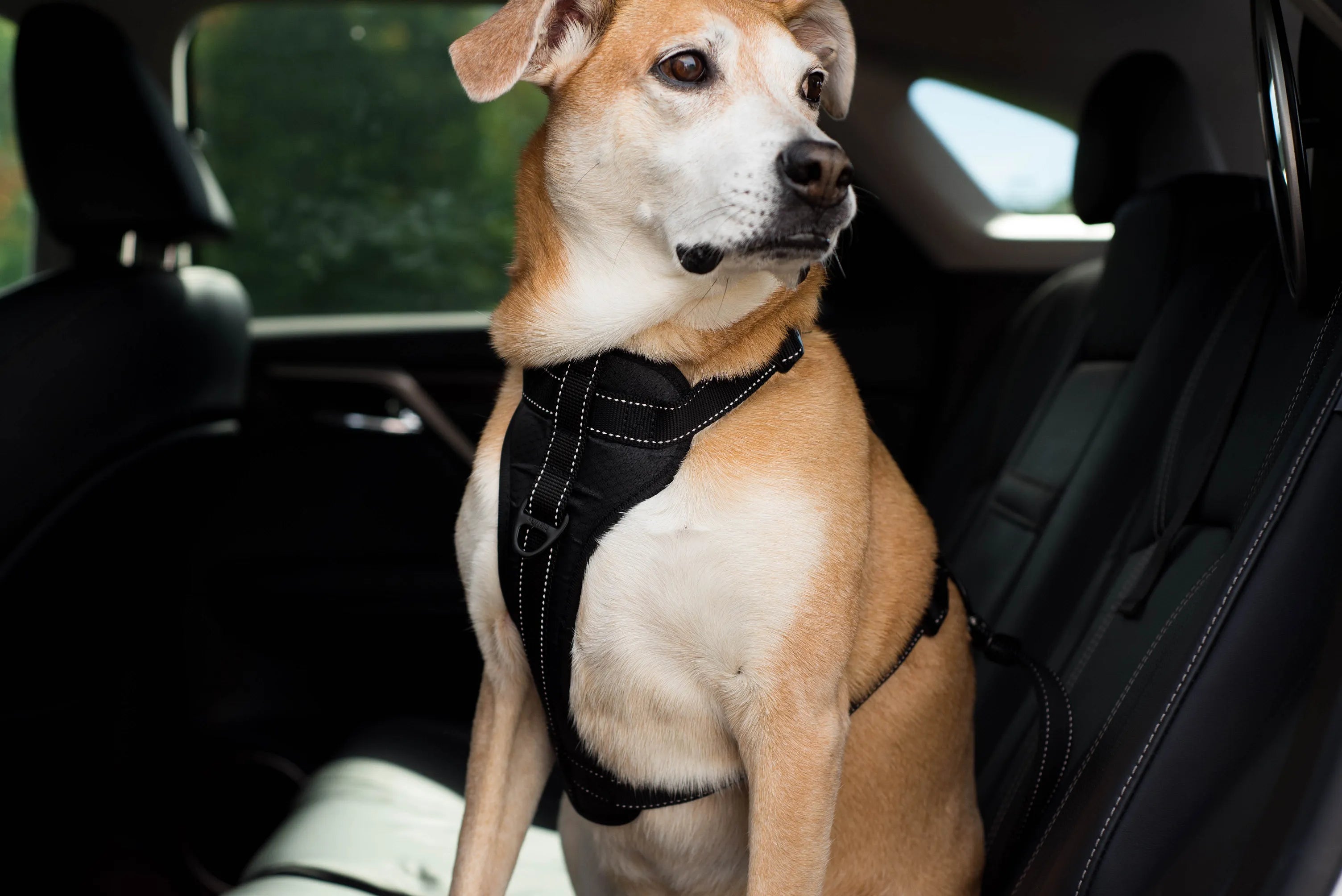
A vehicle safety harness makes sense for medium and large dogs. Above 25–30 pounds, no booster will safely hold your pup. You need a harness designed for car use — wider straps to distribute force, reinforced stitching, and a connection that clicks into your car's seatbelt buckle.
Both options work. The mistake is using the wrong one for your dog's size.
Choosing the Right Option Based on Dog Size
Small Dogs
Under 25 pounds, a booster seat with a real tether system is the move. Look for one that has a weight rating that matches your dog, secures with the vehicle's seatbelt (not just a strap loop), and includes a tether that clips to a harness — not a collar.
Medium Dogs
For dogs roughly 25 to 65 pounds, a vehicle safety harness is almost always the right answer. Booster seats max out, enclosed seats don't fit, and a plain walking harness clipped to a seatbelt isn't built for the forces of a real stop.
That's exactly the gap we built the Mighty Paw Vehicle Safety Harness to fill. It clips directly into your car's seatbelt buckle, has wide padded chest and shoulder straps that distribute force across your dog's body (instead of the neck, the way a collar would), and doubles as a walking harness once you arrive — no swapping gear at rest stops. Our beloved Barley, the reason we started Mighty Paw, is a medium-build mix, and keeping him safely buckled in was one of the first problems we set out to solve.
Large Dogs and Harness-Based Options
For large dogs (65 pounds and up), you have two solid options: a heavy-duty vehicle safety harness rated for your dog's weight, or a crash-tested crate secured in the cargo area of an SUV.
If you go the harness route, sizing is everything. Measure your pup's chest at the widest point and check against the manufacturer's chart. The Mighty Paw Vehicle Safety Harness goes up through large sizes for exactly this reason — bigger dogs deserve the same buckled-in standard as smaller ones, with proportionally stronger construction.

How to Choose a Safe Dog Car Seat for Your Vehicle
A few practical things to check before you buy:
- Your dog's chest measurement. Not estimated — actually measured. This determines size more than breed does.
- Your back seat setup. Bench or contoured? LATCH anchors accessible? The product has to fit your car, not just your dog.
- Whether you'll use it every drive. The best gear is the gear you'll actually use. A complicated setup is one you'll skip on the "quick errand" — and quick errands are when most accidents happen.
Common Dog Car Seat Safety Mistakes
We're going to be straight about what dog parents get wrong, because most of these are fixable in five minutes.
- Clipping the tether to a collar. The single most dangerous mistake. Always use a harness.
- Letting your dog ride in the front seat. Airbag deployment can be fatal. Back seat, every time.
- Buying a "safety" product that hasn't been crash-tested. Marketing claims aren't testing.
- Loose fit. Two-finger gap between strap and dog — snug, not tight.
- Letting your pup hang their head out the window. Cute, but exposes eyes and ears to debris and creates real injury risk in a hard stop.
- Skipping the harness on "quick trips." Most accidents happen within a few miles of home.
Are Dog Car Seats Crash-Tested?
The honest answer most brands won't give you: most aren't. The pet safety industry is largely unregulated. A product can say "safety" on the box without ever being put through a real crash test, because there's no federal standard for dog car seats the way there is for child car seats.
Key Safety Features to Look For
A quick checklist:
- Independent crash-test certification (CPS or equivalent)
- Wide, padded chest and shoulder straps
- Reinforced stitching at every load-bearing seam
- Metal hardware on connection points, not plastic
- A connection method that integrates with your vehicle's seatbelt or LATCH anchors
- Sizing options that match your dog's actual measurements
- For harnesses: dual-purpose design that works for walking too
- Clear documentation of what's been tested and at what speed
Check most of these and you're in the right neighborhood. Check none and it's a fashion accessory with a safety label.
Final Recommendations for Safe Car Travel With Dogs
Here's where we land. The safest setup depends on your dog's size.
For small dogs under 25 pounds, a properly secured booster with a tether clipped to a harness is the right call — crash-test certification, correct fit, harness always, never a collar.
For medium and large dogs, a vehicle safety harness clipped into your car's seatbelt is the right call — wide padded straps, reinforced construction, proper sizing.
The mistake we see most isn't picking the wrong category. It's picking nothing at all. An unrestrained dog on the back seat is the default a lot of dog parents fall into. The fix is gear simple enough that you'll actually use it on the five-minute trip to the vet.
If you've got a medium or larger pup, the Mighty Paw Vehicle Safety Harness is built for exactly this — wide padded straps, reinforced stitching, easy seatbelt integration, and a design that works as a walking harness once you arrive. We wouldn't put it in the lineup if we didn't buckle Barley into it every time we hit the road.
Pick the right gear, fit it right, use it every time. That's the whole game.
Shop the Mighty Paw Vehicle Safety Harness
